Owns an OpenGL buffer with CPU-side staging and synchronization to GPU. More...
#include <spk_buffer_object.hpp>
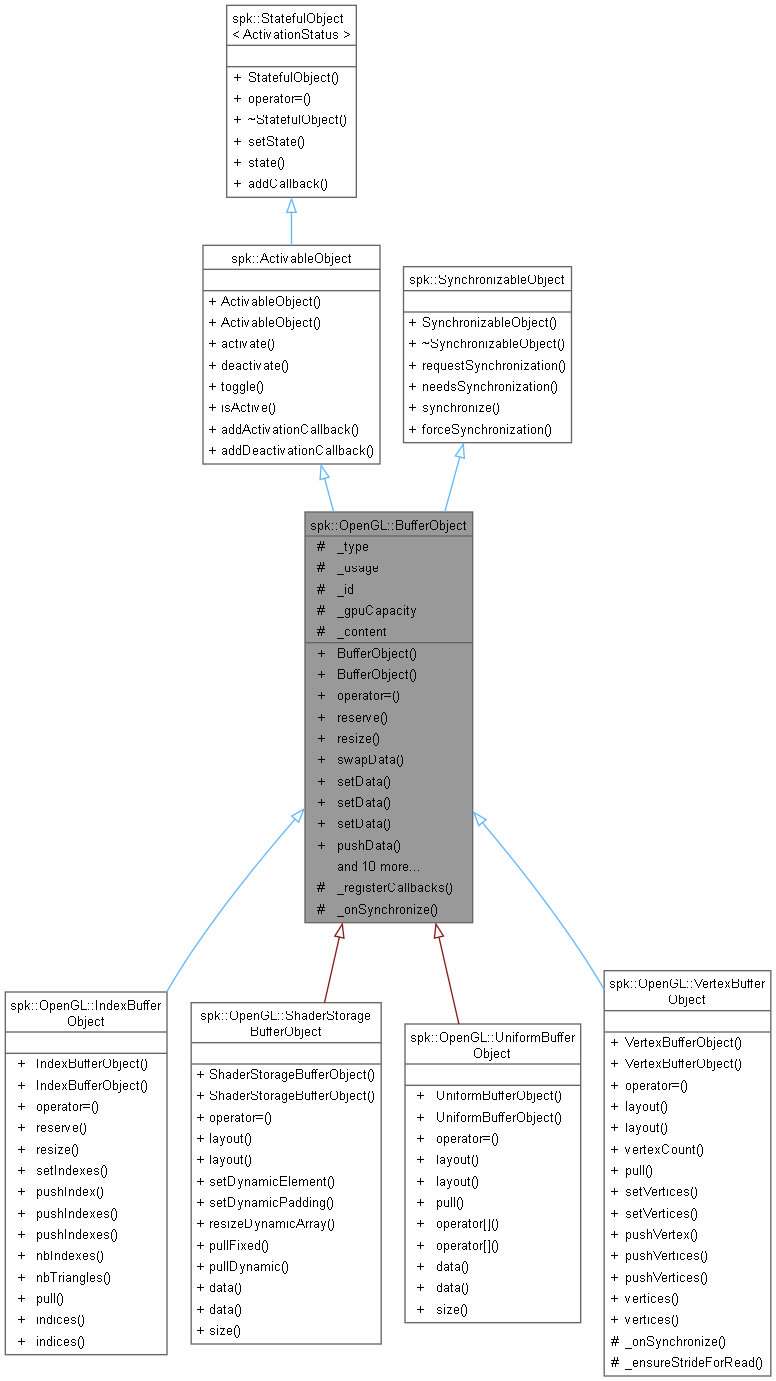
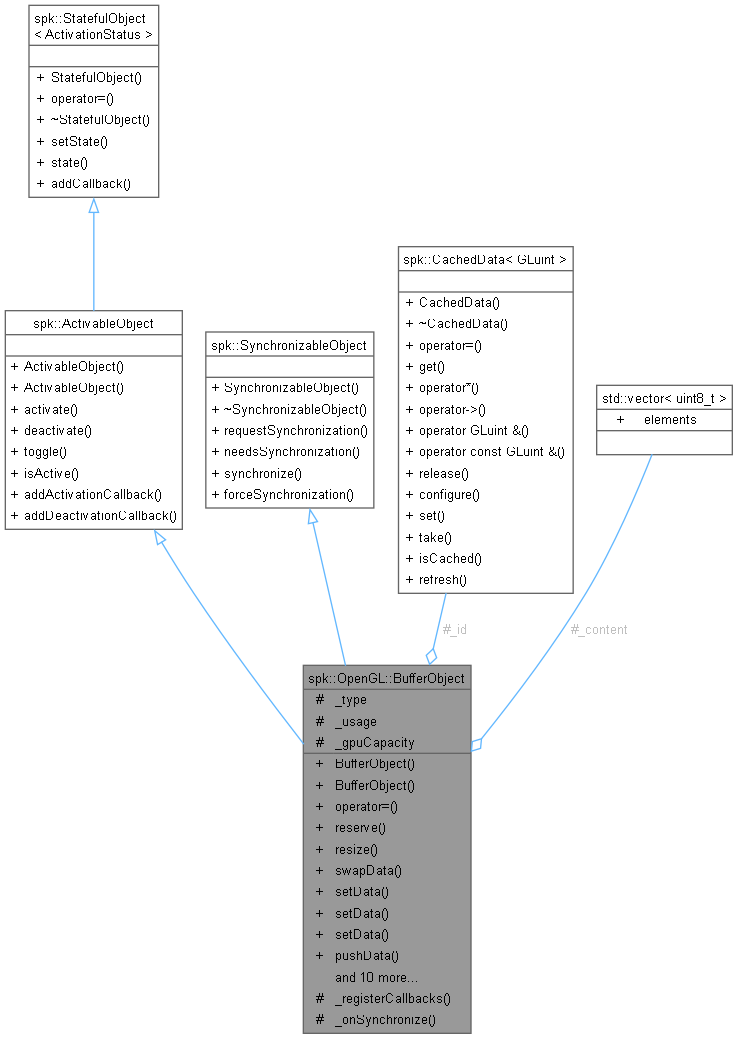
Public Types | |
| enum class | Type : GLenum { Unknow = GL_INVALID_ENUM , Storage = GL_ARRAY_BUFFER , Element = GL_ELEMENT_ARRAY_BUFFER , Uniform = GL_UNIFORM_BUFFER , Texture = GL_TEXTURE_BUFFER , TransformFeedback = GL_TRANSFORM_FEEDBACK_BUFFER , ShaderStorage = GL_SHADER_STORAGE_BUFFER , PixelPack = GL_PIXEL_PACK_BUFFER , PixelUnpack = GL_PIXEL_UNPACK_BUFFER , DrawIndirect = GL_DRAW_INDIRECT_BUFFER , AtomicCounter = GL_ATOMIC_COUNTER_BUFFER } |
| Supported OpenGL binding targets for buffer uploads. | |
| enum class | Usage : GLenum { Unknow = GL_INVALID_ENUM , Static = GL_STATIC_DRAW , Dynamic = GL_DYNAMIC_DRAW , Stream = GL_STREAM_DRAW , StaticRead = GL_STATIC_READ , DynamicRead = GL_DYNAMIC_READ , StreamRead = GL_STREAM_READ , StaticCopy = GL_STATIC_COPY , DynamicCopy = GL_DYNAMIC_COPY , StreamCopy = GL_STREAM_COPY } |
| Usage hints forwarded to the OpenGL driver. | |
| using | Buffer = std::vector<uint8_t> |
| CPU-side byte buffer used as staging before GPU upload. | |
| Public Types inherited from spk::ActivableObject | |
| using | Contract = StatefulObject<ActivationStatus>::Contract |
| Subscription handle controlling callback lifetime. | |
| using | Job = StatefulObject<ActivationStatus>::Job |
| Callback signature executed on activation state changes. | |
| Public Types inherited from spk::StatefulObject< ActivationStatus > | |
| using | Contract |
| Handle allowing subscribers to manage callback lifetimes. | |
| using | Job |
| Callable invoked when the object transitions to a state. | |
Public Member Functions | |
| BufferObject (const Type &p_type, const Usage &p_usage) | |
| Constructs a buffer with target type and usage hint. | |
| BufferObject (const BufferObject &p_other) | |
| Copies buffer configuration and staged content from another buffer. | |
| BufferObject & | operator= (const BufferObject &p_other) |
| Copies buffer configuration and staged content from another buffer. | |
| void | reserve (size_t p_size) |
| Reserves CPU-side storage without changing size. | |
| void | resize (size_t p_size) |
| Resizes CPU-side buffer and marks for sync. | |
| void | swapData (std::vector< uint8_t > &p_data) |
| Swaps CPU staging buffer with external vector. | |
| template<typename TType> | |
| void | setData (const std::vector< TType > &p_data) |
| Replaces buffer contents with a vector of trivially copyable values. | |
| template<typename TType> | |
| void | setData (std::initializer_list< TType > p_data) |
| Replaces buffer contents with an initializer list of values. | |
| void | setData (const void *p_data, size_t p_size) |
| Replaces CPU buffer content with raw data. | |
| void | pushData (const void *p_data, size_t p_size) |
| Appends raw data to CPU buffer. | |
| template<typename TType> | |
| void | pushData (const TType &p_value) |
| Appends a single trivially copyable value to the buffer. | |
| template<typename TType> | |
| void | pushData (const std::vector< TType > &p_values) |
| Appends a vector of trivially copyable values to the buffer. | |
| template<typename TType> | |
| void | pushData (std::initializer_list< TType > p_values) |
| Appends an initializer list of trivially copyable values to the buffer. | |
| void | editData (const void *p_data, size_t p_offset, size_t p_size) |
| Overwrites a range of the CPU buffer. | |
| template<typename TType> | |
| void | editData (const TType &p_value, size_t p_offset) |
| Overwrites part of the buffer with a single value. | |
| size_t | size () const |
| Returns the current CPU buffer size. | |
| Buffer & | buffer () |
| Mutable access to the CPU staging buffer. | |
| const Buffer & | buffer () const |
| Const access to the CPU staging buffer. | |
| Buffer::value_type * | data () |
| Mutable pointer to underlying bytes. | |
| const Buffer::value_type * | data () const |
| Const pointer to underlying bytes. | |
| Public Member Functions inherited from spk::ActivableObject | |
| ActivableObject () | |
| Builds a deactivated object. | |
| ActivableObject (ActivationStatus p_initial) | |
| Builds with a custom initial activation state. | |
| void | activate () |
| Sets the state to Activated. | |
| void | deactivate () |
| Sets the state to Deactivated. | |
| void | toggle () |
| Toggles between activated and deactivated states. | |
| bool | isActive () const |
| Checks whether the object is currently activated. | |
| Contract | addActivationCallback (const Job &p_callback) |
| Registers a callback executed when the object activates. | |
| Contract | addDeactivationCallback (const Job &p_callback) |
| Registers a callback executed when the object deactivates. | |
| Public Member Functions inherited from spk::StatefulObject< ActivationStatus > | |
| StatefulObject (const ActivationStatus &p_initialState) | |
| Builds with an initial state. | |
| StatefulObject & | operator= (const StatefulObject &p_other)=delete |
| void | setState (const ActivationStatus &p_newState) |
| Sets a new state and triggers callbacks registered for it. | |
| ActivationStatus | state () const |
| Returns the current state. | |
| Contract | addCallback (const ActivationStatus &p_state, const Job &p_callback) |
| Subscribes a callback for a specific state. | |
| Public Member Functions inherited from spk::SynchronizableObject | |
| void | requestSynchronization () noexcept |
| Marks the object as needing synchronization. | |
| bool | needsSynchronization () const noexcept |
| Checks if synchronization is pending. | |
| void | synchronize () |
| Performs synchronization if requested. | |
| void | forceSynchronization () |
| Forces synchronization regardless of current flag. | |
Protected Member Functions | |
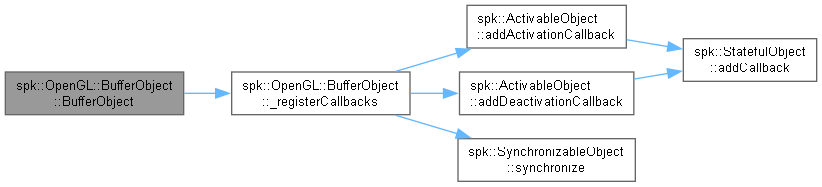
| void | _registerCallbacks () |
| Registers GPU lifecycle callbacks with the cached buffer id. | |
| void | _onSynchronize () override |
| Uploads staged data to the GPU when synchronization is requested. | |
Protected Attributes | |
| Type | _type |
| Buffer target selected at construction. | |
| Usage | _usage |
| Driver usage hint selected at construction. | |
| spk::CachedData< GLuint > | _id |
| Lazily created GPU buffer identifier. | |
| size_t | _gpuCapacity = 0 |
| Capacity reserved on the GPU for the current buffer. | |
| Buffer | _content |
| CPU staging area mirrored to GPU on synchronization. | |
Detailed Description
Owns an OpenGL buffer with CPU-side staging and synchronization to GPU.
Constructor & Destructor Documentation
◆ BufferObject() [1/2]
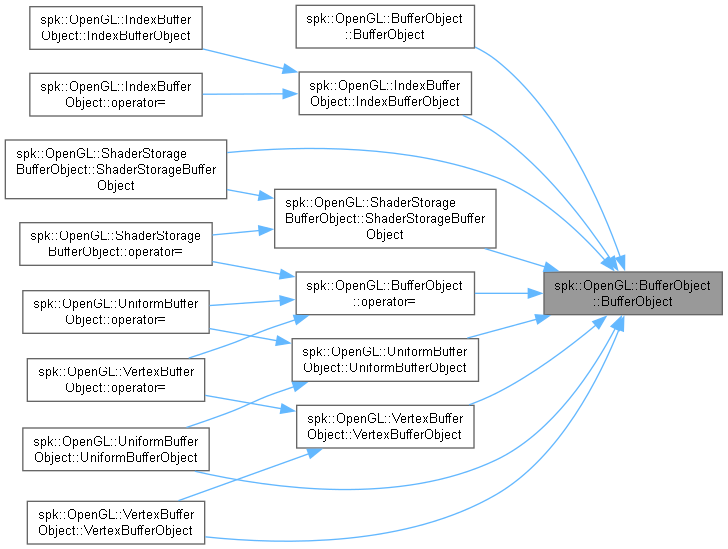
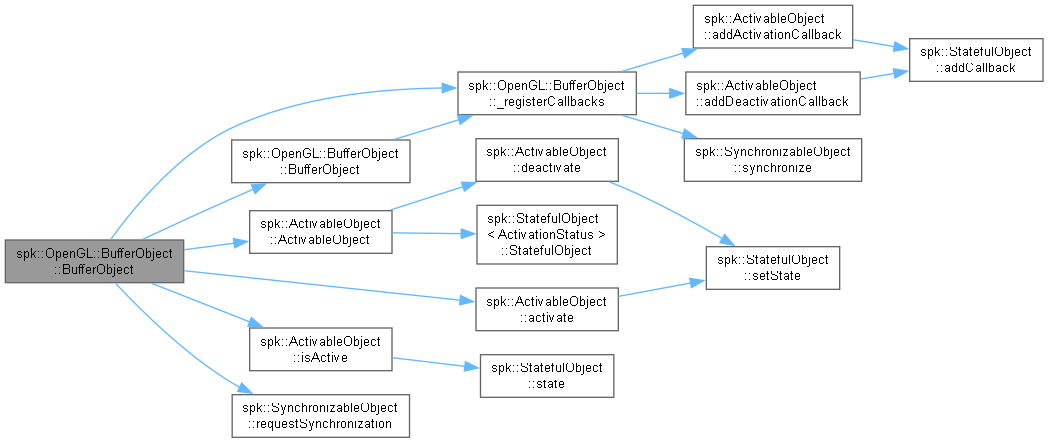
◆ BufferObject() [2/2]
| spk::OpenGL::BufferObject::BufferObject | ( | const BufferObject & | p_other | ) |
Copies buffer configuration and staged content from another buffer.
- Parameters
-
p_other Source buffer.
Member Function Documentation
◆ _onSynchronize()
|
overrideprotectedvirtual |
Uploads staged data to the GPU when synchronization is requested.
Implements spk::SynchronizableObject.
Reimplemented in spk::OpenGL::VertexBufferObject.

◆ buffer() [1/2]
| BufferObject::Buffer & spk::OpenGL::BufferObject::buffer | ( | ) |
Mutable access to the CPU staging buffer.
- Returns
- Reference to the buffer vector.
◆ buffer() [2/2]
| const BufferObject::Buffer & spk::OpenGL::BufferObject::buffer | ( | ) | const |
Const access to the CPU staging buffer.
- Returns
- Const reference to the buffer vector.
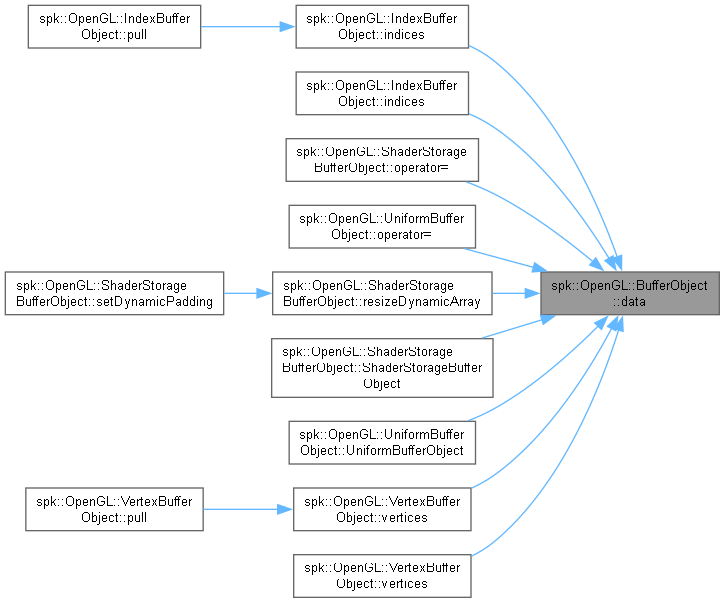
◆ data() [1/2]
| BufferObject::Buffer::value_type * spk::OpenGL::BufferObject::data | ( | ) |
Mutable pointer to underlying bytes.
- Returns
- Pointer or nullptr if empty.
◆ data() [2/2]
| const BufferObject::Buffer::value_type * spk::OpenGL::BufferObject::data | ( | ) | const |
Const pointer to underlying bytes.
- Returns
- Pointer or nullptr if empty.
◆ editData() [1/2]
|
inline |
Overwrites part of the buffer with a single value.
- Template Parameters
-
TType Trivially copyable type written into the buffer.
- Parameters
-
p_value Value to copy. p_offset Byte offset where the value should be written.

◆ editData() [2/2]
| void spk::OpenGL::BufferObject::editData | ( | const void * | p_data, |
| size_t | p_offset, | ||
| size_t | p_size ) |
Overwrites a range of the CPU buffer.
- Parameters
-
p_data Source pointer. p_offset Byte offset to start writing. p_size Number of bytes to write.


◆ operator=()
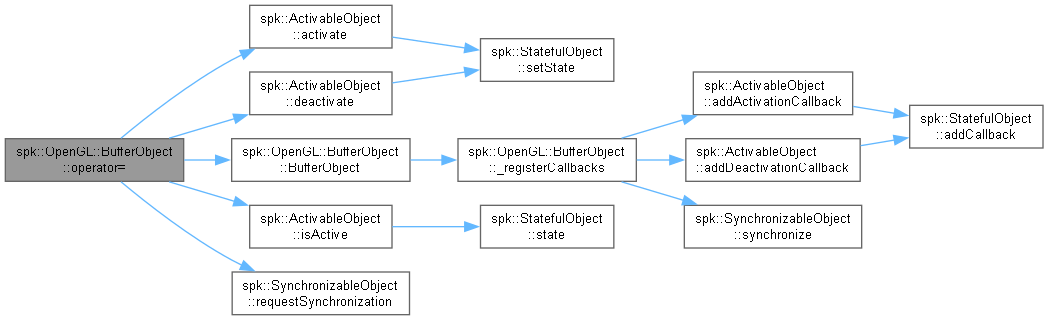
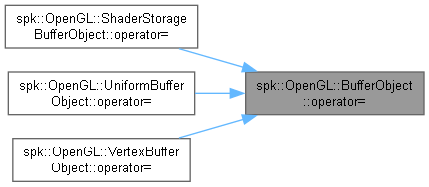
| BufferObject & spk::OpenGL::BufferObject::operator= | ( | const BufferObject & | p_other | ) |
Copies buffer configuration and staged content from another buffer.
- Parameters
-
p_other Source buffer.
- Returns
- Reference to this buffer.
◆ pushData() [1/4]
|
inline |
Appends a vector of trivially copyable values to the buffer.
- Template Parameters
-
TType Trivially copyable type to append.
- Parameters
-
p_values Values to append.

◆ pushData() [2/4]
|
inline |
Appends a single trivially copyable value to the buffer.
- Template Parameters
-
TType Trivially copyable type to append.
- Parameters
-
p_value Value to append.

◆ pushData() [3/4]
| void spk::OpenGL::BufferObject::pushData | ( | const void * | p_data, |
| size_t | p_size ) |
Appends raw data to CPU buffer.
- Parameters
-
p_data Source pointer. p_size Byte size.

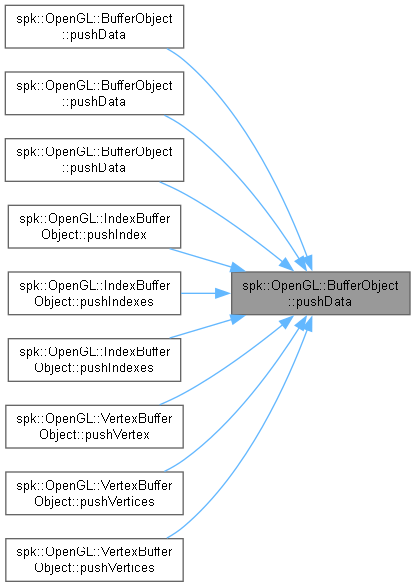
◆ pushData() [4/4]
|
inline |
Appends an initializer list of trivially copyable values to the buffer.
- Template Parameters
-
TType Trivially copyable type to append.
- Parameters
-
p_values Values to append.

◆ reserve()
| void spk::OpenGL::BufferObject::reserve | ( | size_t | p_size | ) |
Reserves CPU-side storage without changing size.
- Parameters
-
p_size Bytes to reserve.

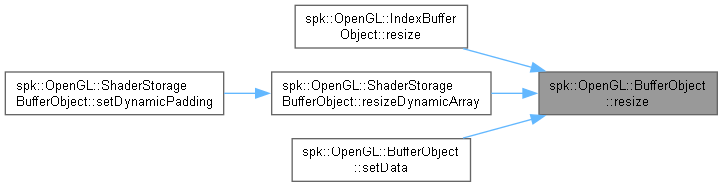
◆ resize()
| void spk::OpenGL::BufferObject::resize | ( | size_t | p_size | ) |
Resizes CPU-side buffer and marks for sync.
- Parameters
-
p_size New size in bytes.
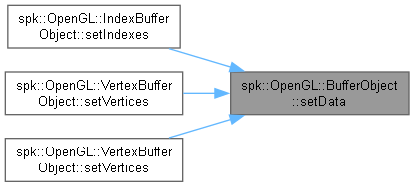
◆ setData() [1/3]
|
inline |
Replaces buffer contents with a vector of trivially copyable values.
- Template Parameters
-
TType Trivially copyable element type stored in the buffer.
- Parameters
-
p_data Data vector to copy from.

◆ setData() [2/3]
| void spk::OpenGL::BufferObject::setData | ( | const void * | p_data, |
| size_t | p_size ) |
Replaces CPU buffer content with raw data.
- Parameters
-
p_data Source pointer. p_size Byte size.
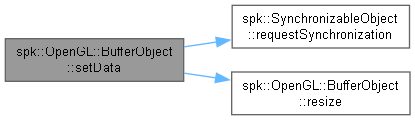
◆ setData() [3/3]
|
inline |
Replaces buffer contents with an initializer list of values.
- Template Parameters
-
TType Trivially copyable element type stored in the buffer.
- Parameters
-
p_data Data list to copy from.

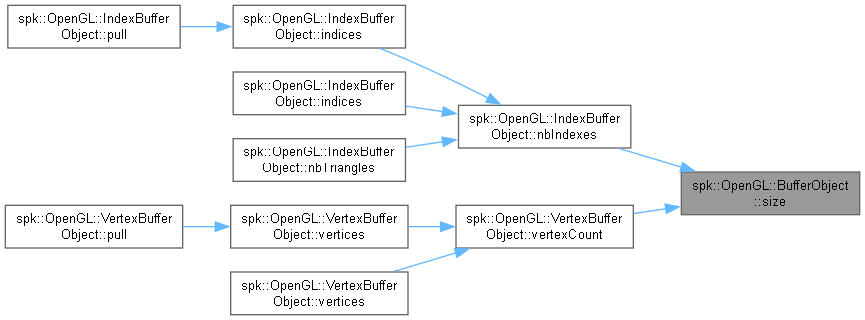
◆ size()
| size_t spk::OpenGL::BufferObject::size | ( | ) | const |
Returns the current CPU buffer size.
- Returns
- Byte size.
◆ swapData()
| void spk::OpenGL::BufferObject::swapData | ( | std::vector< uint8_t > & | p_data | ) |
Swaps CPU staging buffer with external vector.
- Parameters
-
p_data Vector to swap with.

The documentation for this class was generated from the following files:
- includes/structure/opengl/spk_buffer_object.hpp
- srcs/structure/opengl/spk_buffer_object.cpp