Point in time with conversion helpers and arithmetic with Duration. More...
#include <spk_timestamp.hpp>
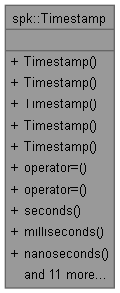
Public Member Functions | |
| Timestamp () | |
| Captures current time in nanoseconds. | |
| Timestamp (long double p_value, TimeUnit p_unit) | |
| Builds a timestamp from a raw value and unit. | |
| Timestamp (const Duration &p_duration) | |
| Builds a timestamp located after the origin by the given duration. | |
| Timestamp (const Timestamp &p_other) | |
| Copies timestamp value and caches from another instance. | |
| Timestamp (Timestamp &&p_other) noexcept | |
| Moves timestamp value and caches from another instance. | |
| Timestamp & | operator= (const Timestamp &p_other) |
| Copies timestamp value and caches from another instance. | |
| Timestamp & | operator= (Timestamp &&p_other) noexcept |
| Moves timestamp value and caches from another instance. | |
| double | seconds () const |
| Returns the timestamp expressed in seconds. | |
| long long | milliseconds () const |
| Returns the timestamp expressed in milliseconds. | |
| long long | nanoseconds () const |
| Returns the timestamp expressed in nanoseconds. | |
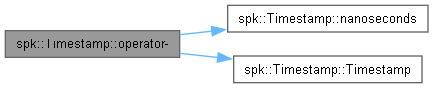
| Duration | operator- (const Timestamp &p_other) const |
| Computes the duration separating two timestamps. | |
| Timestamp | operator+ (const Duration &p_other) const |
| Shifts the timestamp forward by a duration. | |
| Timestamp | operator- (const Duration &p_other) const |
| Shifts the timestamp backward by a duration. | |
| Timestamp & | operator+= (const Duration &p_other) |
| Adds a duration to this timestamp in place. | |
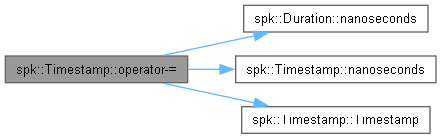
| Timestamp & | operator-= (const Duration &p_other) |
| Subtracts a duration from this timestamp in place. | |
| bool | operator== (const Timestamp &p_other) const |
| Equality comparison using canonical nanoseconds. | |
| bool | operator!= (const Timestamp &p_other) const |
| Inequality comparison using canonical nanoseconds. | |
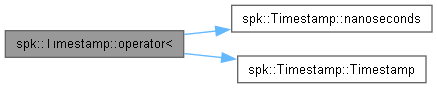
| bool | operator< (const Timestamp &p_other) const |
| Strictly-less comparison using canonical nanoseconds. | |
| bool | operator> (const Timestamp &p_other) const |
| Strictly-greater comparison using canonical nanoseconds. | |
| bool | operator<= (const Timestamp &p_other) const |
| Less-or-equal comparison using canonical nanoseconds. | |
| bool | operator>= (const Timestamp &p_other) const |
| Greater-or-equal comparison using canonical nanoseconds. | |
Detailed Description
Point in time with conversion helpers and arithmetic with Duration.
Constructor & Destructor Documentation
◆ Timestamp() [1/4]
| spk::Timestamp::Timestamp | ( | long double | p_value, |
| TimeUnit | p_unit ) |
Builds a timestamp from a raw value and unit.
- Parameters
-
p_value Numeric representation of the moment. p_unit Unit associated with the value.
◆ Timestamp() [2/4]
| spk::Timestamp::Timestamp | ( | const Duration & | p_duration | ) |
Builds a timestamp located after the origin by the given duration.
- Parameters
-
p_duration Offset from the origin time.

◆ Timestamp() [3/4]
| spk::Timestamp::Timestamp | ( | const Timestamp & | p_other | ) |
Copies timestamp value and caches from another instance.
- Parameters
-
p_other Timestamp to copy.

◆ Timestamp() [4/4]
|
noexcept |
Moves timestamp value and caches from another instance.
- Parameters
-
p_other Timestamp to move.

Member Function Documentation
◆ milliseconds()
| long long spk::Timestamp::milliseconds | ( | ) | const |
Returns the timestamp expressed in milliseconds.
- Returns
- Point in time as milliseconds.
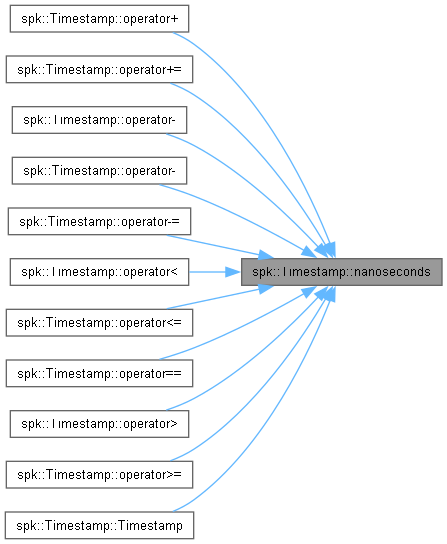
◆ nanoseconds()
| long long spk::Timestamp::nanoseconds | ( | ) | const |
Returns the timestamp expressed in nanoseconds.
- Returns
- Point in time as nanoseconds.
◆ operator!=()
| bool spk::Timestamp::operator!= | ( | const Timestamp & | p_other | ) | const |
Inequality comparison using canonical nanoseconds.
- Parameters
-
p_other Timestamp to compare.
- Returns
- true when timestamps differ.

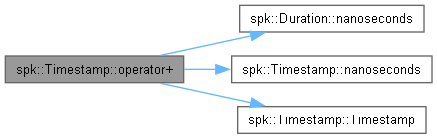
◆ operator+()
Shifts the timestamp forward by a duration.
- Parameters
-
p_other Duration to add.
- Returns
- Updated timestamp.
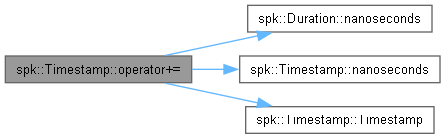
◆ operator+=()
Adds a duration to this timestamp in place.
- Parameters
-
p_other Duration to add.
- Returns
- Reference to this timestamp.
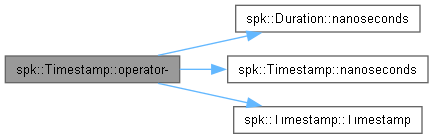
◆ operator-() [1/2]
Shifts the timestamp backward by a duration.
- Parameters
-
p_other Duration to subtract.
- Returns
- Updated timestamp.
◆ operator-() [2/2]
◆ operator-=()
Subtracts a duration from this timestamp in place.
- Parameters
-
p_other Duration to subtract.
- Returns
- Reference to this timestamp.
◆ operator<()
| bool spk::Timestamp::operator< | ( | const Timestamp & | p_other | ) | const |
Strictly-less comparison using canonical nanoseconds.
- Parameters
-
p_other Timestamp to compare.
- Returns
- true when this timestamp is earlier.
◆ operator<=()
| bool spk::Timestamp::operator<= | ( | const Timestamp & | p_other | ) | const |
Less-or-equal comparison using canonical nanoseconds.
- Parameters
-
p_other Timestamp to compare.
- Returns
- true when this timestamp is earlier or equal.

◆ operator=() [1/2]
Copies timestamp value and caches from another instance.
- Parameters
-
p_other Timestamp to copy.
- Returns
- Reference to this timestamp.

◆ operator=() [2/2]
Moves timestamp value and caches from another instance.
- Parameters
-
p_other Timestamp to move.
- Returns
- Reference to this timestamp.

◆ operator==()
| bool spk::Timestamp::operator== | ( | const Timestamp & | p_other | ) | const |
Equality comparison using canonical nanoseconds.
- Parameters
-
p_other Timestamp to compare.
- Returns
- true when timestamps are identical.

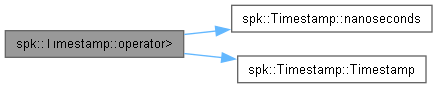
◆ operator>()
| bool spk::Timestamp::operator> | ( | const Timestamp & | p_other | ) | const |
Strictly-greater comparison using canonical nanoseconds.
- Parameters
-
p_other Timestamp to compare.
- Returns
- true when this timestamp is later.
◆ operator>=()
| bool spk::Timestamp::operator>= | ( | const Timestamp & | p_other | ) | const |
Greater-or-equal comparison using canonical nanoseconds.
- Parameters
-
p_other Timestamp to compare.
- Returns
- true when this timestamp is later or equal.

◆ seconds()
| double spk::Timestamp::seconds | ( | ) | const |
Returns the timestamp expressed in seconds.
- Returns
- Point in time as seconds.
The documentation for this class was generated from the following files:
- includes/structure/system/time/spk_timestamp.hpp
- srcs/structure/system/time/spk_timestamp.cpp